You do not need to start with a product name. Start with the part of your backyard that is giving you trouble.
If bugs keep driving you off the patio, a smaller screened area may solve the problem. If leaves, insects, and dirt keep reaching the pool and deck, you may need a larger enclosure around the whole pool area. If both spaces work as one, the best plan may cover both.
That is the real decision behind screen enclosure vs pool enclosure for a Florida home. The label matters less than the footprint, exposure, and way you use the yard.
Should You Screen the Patio or Enclose the Entire Pool Area?
The better choice depends on where you spend time and where the problem actually happens.
You may start by searching for a screen enclosure because mosquitoes make dinner outside miserable. Then you see pool enclosures, a pool cage, and a screened lanai. The terms can feel like different products even when they overlap.
Separate terminology from project scope. If you want the naming issue explained first, our guide to pool cage and pool enclosure covers how those terms are commonly used in Florida.
For your project, focus on three possibilities:
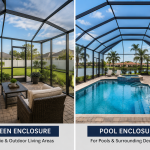
Enclose the patio or seating zone.
Enclose the pool area and surrounding pool deck.
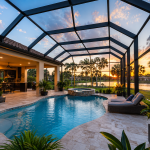
Extend one screened structure across both.
Your goal is to create the right boundary around the part of the property you want to use and protect.
The Right Enclosure Depends on What You Want Protected
You should choose the project scope based on the problem area, not the name on the proposal.
If your main problem is bugs around a table, a Florida patio enclosure may be enough. You can reduce insects, fallen leaves, and windblown debris around the seating zone without covering the whole backyard.
If the problem reaches the water, the decision changes. A pool enclosure can cover the swimming pool, deck, and nearby seating so the whole area works as one protected zone.
On an open-air pool, palm pieces and dirt can spread across the water and deck. A larger screened footprint can reduce cleanup, though it will not eliminate pool maintenance.
If the patio and pool already function as one outdoor space, separate zones can create extra doors and awkward transitions.
The practical takeaway is simple: screen enclosure vs pool enclosure gets easier once you stop asking which one is better and ask which part of the backyard needs the barrier.
Screen enclosure vs Pool enclosure: What Actually Changes?
The biggest differences are footprint, structural span, exposure, sightlines, and how much of the backyard sits inside the screened boundary.
Decision Factor | Patio / General Screen Enclosure | Pool Enclosure |
Area covered | Patio or seating zone | Pool plus surrounding deck |
Main goal | Comfort and insect control | Whole pool-area usability |
Typical footprint | More compact | Often larger |
Framing span | Usually shorter | May require wider spans |
View impact | More localized | More noticeable across the yard |
Upkeep | Smaller system to inspect | More screen, framing, doors, and connections |
A larger structure adds more screen panels, more framing, more connection points, and more surface area exposed to sun, rain, humidity, and strong winds.
A patio close to the house may be partly sheltered, while a full pool enclosure often reaches farther into open exposure.
A large pool structure can place framing across a broad sightline, which matters on waterfront, golf-course, or preserve lots.
For many Florida homeowners, the better comparison is not which system has more features. It is how much structure you want around your daily view and routine.
Tampa, Sarasota, and Gulf Coast Conditions Can Change the Decision
Your location can change how hard the enclosure has to work.
An aluminum frame suits Florida well, but fasteners, door hardware, coatings, and connections still need the right specifications and care. Corrosion often appears first around small components, damaged finishes, or areas that stay wet.
Mature trees can add leaves and branches to the screen, while preserve lots may bring more insects, snakes, or other uninvited guests.
Be cautious with broad hurricane claims. A larger enclosure should be designed specifically for the site, dimensions, applicable wind loads, and local requirements. A generic hurricane-rated label does not tell you enough.
For homes in southwest Florida, especially near the coast, screen enclosure vs pool enclosure should include a serious look at exposure before you compare price alone.
Screen Choice Should Follow the Problem
You should choose mesh based on airflow, visibility, insect pressure, and how the area is used.
A tighter screen can help with tiny biting insects, but it may reduce airflow compared with more open mesh. Near a dining patio, that tradeoff may be worth it. Across a wide pool view, you may care more about clarity and natural light.
The seating zone may favor tighter insect control while a broad pool wall favors clearer visibility.
The best screen is the one that matches the problem you are solving.
Use This 5-Question Test Before Choosing an Enclosure
You can narrow the decision quickly by answering five practical questions before requesting quotes.
1. Where Do You Spend the Most Time Outside?
Start with your normal routine. If most of your time is on the patio, you may not need to enclose the whole pool. If you swim, supervise children, entertain, and lounge around the water, the pool area may be the center of your outdoor life.
Plan around an ordinary week, not the biggest party of the year.
2. Where Are Bugs and Debris Actually Creating Problems?
Find the source of the frustration. If mosquitoes attack near the back door but the water stays fairly clean, a patio enclosure may solve the bigger problem. If fallen leaves, dirt, bugs, and small animals keep reaching the water, enclosing only the patio may leave you with the same chores.
It helps you avoid paying for coverage you do not need.
3. Do You Want the Pool and Patio to Feel Like One Space?
If you move between both areas all day, one combined enclosure may work better. Splitting a connected patio and pool footprint can reduce usable living space and add unnecessary transitions.
A combined layout can let you move naturally from shade to water.
4. How Important Is the Backyard View?
The bigger the structure, the more its framing can affect what you see. Open-view layouts may reduce visual interruption where engineering allows, but they can also affect structural requirements and cost.
Decide how much the view matters before fabrication. It is easier to plan sightlines than to wish a post had moved after installation.
5. How Exposed Is Your Property to Florida Weather?
More exposure usually means more attention to design, hardware, and upkeep. Look at salt air, nearby trees, open water, wind, and how much shade the house provides. Heavy rain, UV, and summer heat all work on the structure over time.
A screened project has little insulation and is not a solid roof room. You still get outdoor temperatures and humidity even though screening can make the area more comfortable.
This is where screen enclosure vs pool enclosure also becomes a maintenance decision. More coverage means more material to inspect, clean, and eventually repair.
When a Patio Screen Enclosure Is Usually the Better Fit
A patio-focused enclosure is usually better when your main goal is comfortable outdoor living close to the house.
You may want a screened patio enclosure if bugs ruin meals, furniture collects debris, or you want a more usable seating area without covering the full pool.
The smaller footprint can keep the project focused and leave less screen and framing to maintain.
During the cooler months, screening can also reduce some direct wind across seating while keeping the area open to outside air. If seasonal comfort matters, see using a patio enclosure in cooler Florida weather.
Existing slabs, roof connections, doors, dimensions, and site conditions still affect cost.
If your biggest frustration starts and ends near the patio, you may not need to build around the whole pool.
When a Pool Enclosure Is Usually the Better Fit
A pool enclosure is usually stronger when the pool and surrounding deck are the main problem area.
If you constantly skim leaves, chase bugs away from swimmers, or find small animals near the water, a Florida pool enclosure can protect a much larger footprint.
You also get one screened zone around the water, seating, and walking paths.
A larger enclosure brings more materials, screen, and framing into the project. Your proposal should account for engineering, access doors, roof configuration, hardware, and deck size.
For a pool-centered backyard, screen enclosure vs pool enclosure usually comes down to whether protecting only the patio would leave your main problems untouched.
When a Combined Pool and Patio Enclosure Makes More Sense
A combined layout makes sense when the backyard already works as one connected outdoor room.
You may have a covered patio opening directly onto the deck, a grill beside the water, and seating spread across both. One larger screened boundary can feel more natural than separate enclosures.
Every extra foot changes framing, screen area, roof geometry, doors, and sightlines. Map how you move through the area and which views you want open.
Sometimes the best answer is not patio versus pool. It is choosing the right line around both.
What to Show an Enclosure Contractor Before Asking for a Quote
You will get a more useful proposal if you show how the backyard works before asking for a number.
Bring:
Photos from the house looking toward the pool and patio
Approximate patio and deck dimensions
Areas where bugs or debris are worst
Doors and walking paths you use most
Views you want to preserve
Existing corrosion, damage, or old screen
Plans to extend the outdoor area later
Ask what screen product is included, what hardware will be used, who handles permits, and what the warranty covers. Two bids with the same enclosure label can describe very different builds.
Choose the Enclosure Around Your Backyard, Not the Label
You make the better investment when the enclosure fits how you actually use the property.
A patio-focused project may be enough if your concern is comfort near the house. A full pool enclosure can make more sense when the water, deck, and poolside seating all need protection. A combined design may be cleaner when those areas already work together.
Creative Pool Cages helps you evaluate the footprint before pushing you toward a product. Your layout, exposure, sightlines, screen needs, and long-term maintenance all matter before the first piece of aluminum is installed.
If you are comparing screen enclosure vs pool enclosure for your Florida home, start with the backyard itself. Creative Pool Cages can help turn that decision into a practical design built around how you use the space, not just what the structure is called.
Frequently Asked Questions
Is a screen enclosure the same as a pool enclosure in Florida?
Not always. A screen enclosure can cover a patio, lanai, or other outdoor area, while a pool enclosure is designed around the pool and surrounding deck.
Is it better to screen only the patio or the entire pool area?
It depends on where the problem occurs. If bugs and debris mainly affect the patio, a smaller enclosure may be enough; if the pool and deck are affected too, a full pool enclosure usually makes more sense.
Can one enclosure cover both a patio and a pool?
Yes. Many Florida homes use one larger screened structure to cover the patio, pool deck, and swimming pool as one connected outdoor space.
Which screen is best for a Florida enclosure?
The best screen depends on the property and the main concern. Standard insect mesh works well for general use, while tighter no-see-um screens can improve insect control but may reduce airflow.
How do I know how much of my backyard to enclose?
Start with how you use the space. Consider where you sit, swim, entertain, deal with insects, collect debris, and want to preserve views before choosing the enclosure footprint.