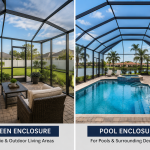
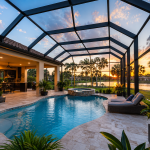
Most people don’t notice their pool cage until they hear the first rip.
It’s a small sound. Easy to ignore at first. Maybe after a windy afternoon or one of those quick Sarasota storms. Then you see it. A tear in the screen. Not huge, but enough.
You leave it for a bit. Then it gets bigger. Bugs start getting in. Debris too. Now it’s not something you can ignore.
So you fix it.
Then, a few months later, another spot gives out.
That’s usually when the question hits. Do you keep going with pool rescreening… or is it time to step back and look at pool cage replacement?
In Florida, especially around Naples and Sarasota, this isn’t a one-time decision. The weather pushes these enclosures hard. Sun, humidity, storms. Everything adds up.
So this isn’t about what’s cheaper right now. It’s about what actually holds up.
Why Pool Enclosures Add Real Value in Southwest Florida
Walk outside mid-day in Sarasota without a screen enclosure. You’ll feel it right away.
Heat. Glare. Bugs are moving through the air like it’s their space.
Now step into a clean, tight pool enclosure. Big difference.
It’s quieter. More usable. You actually want to sit out there.
That’s the part people don’t always expect. A good pool cage doesn’t just protect. It changes how you use the space. Morning coffee feels easier. Evenings last longer. You’re not rushing back inside.
There’s also the practical side, which matters just as much:
Less debris after storms
Fewer bugs getting in
Less cleaning overall
Better value when selling
In Naples, buyers notice outdoor spaces. They look at the pool, the patio screening, and the condition of the enclosure. A clean setup tells a story. It says the home’s been taken care of.
A worn-out screen says something else.
Pool Cage Replacement vs Rescreening in Florida: What’s the Real Difference?
On the surface, it feels like a simple choice. Replace the screen or replace the whole thing. But once you look closer, these are two very different paths.
What Pool Rescreening Actually Includes
Pool rescreening is focused on the surface. You’re dealing with the screen mesh, and that’s it.
Removing damaged screen panels
Installing new mesh
Tightening everything back up
If the structure is still solid, this works well.
Say a storm rolls through Sarasota and a branch hits the enclosure. A few panels are torn, yet everything else is fine. That’s a clean case for pool rescreening.
You fix it. It looks fresh again, and then you move on. But here’s what it doesn’t do. It doesn’t fix the frame, and it doesn’t address rust either. It doesn’t strengthen weak joints.
So if the problem is deeper, you’re only covering it up.
What Pool Cage Replacement Means
Pool cage replacement is a full reset. There is a new frame, new screen material, and fasteners. Everything.
A good pool cage builder rebuilds the entire structure so it meets current standards. Stronger connections. Better support. Built for Florida conditions now, not 20 years ago.
You’ll usually see this with older enclosures in Naples. From a distance, they look okay. Up close, not so much. Slight sagging. Loose sections. The screen won’t stay tight anymore.
That’s when replacing everything starts to make sense.
Why This Decision Is Different in Florida
Florida speeds things up. The sun alone breaks down screen material faster than most people expect. Add humidity, and you start seeing issues with fasteners. Then storms come through and hit multiple panels at once.
That’s why pool rescreening here usually lands in that 7 to 10 year range.
Sometimes less.
So when you feel like you’re fixing the screen more often than you should, it’s not just bad luck. It’s the environment doing its thing.
And that’s what makes this decision different. You’re not choosing between two equal options. You’re choosing based on how Florida wears things down over time.
When Rescreening Makes Sense (And When It Doesn’t)
There’s a point where pool rescreening is the right move. No question. And there’s a point where it just becomes a cycle.
When Pool Rescreening Works
You’re in a good spot if:
Damage is limited to only a few panels.
The frame feels solid.
No visible rust or movement
This is common after a single storm. A few tears. Nothing major.
You bring in a professional. They handle the screen repair or even a full rescreen. Everything looks clean again.
You’re back to normal.
When It Starts Falling Apart
This is where things get tricky.
You start noticing:
Tears showing up in different areas
Sections that feel a little loose
The mesh is not staying tight.
You fix one section. Then another. At first, it feels manageable. Affordable, maybe, and no big deal. But after a while, it starts adding up. Not just money, time, and even frustration.
That’s when pool cage rescreening stops being a solution and starts being a pattern.
When Pool Cage Replacement Becomes the Better Investment
This is usually the harder call. But it’s also the one that fully solves the problem.
When the Structure Is the Issue
Look for signs like:
Rust around joints or fasteners
Sagging sections
Movement when you push on the frame
These aren’t screen problems but more structural. No amount of pool rescreening fixes that.
When Age Catches Up
There is a certain point where an older pool cage just starts to tell on itself. It might be 20 years old, or maybe it’s pushed even further, but you can feel the age in the metal. It’s lived through a couple of decades of Florida’s heavy lifting. The kind of heat that softens everything and the storms that never seem to quit.
Even if it looks decent enough from the patio, the frame just doesn’t have the “give” it used to. You can bring someone in to do a full rescreen, and it’ll look great for a week, but then the sagging starts. The frame won’t hold the tension anymore. It’s tired. When a fresh screen won’t stay tight, that’s usually the structure telling you it’s done with the quick fixes.
The Repeat Repair Loop
This is where most homeowners get stuck.
You fix one section. Then another. Then a full rescreen. Then, there will be more screen repairs later.
Individually, each one feels affordable. Together, they’re not.
At some point, the total cost of repeated pool rescreening gets close to a full pool cage replacement. The difference is, you’re still dealing with an aging setup. That’s usually when people decide to just replace it and be done with it.
Cost Comparison in Florida: Rescreening vs Replacement
Let’s talk numbers. But keep them in context.
Rescreening Costs
Pool rescreening usually takes place around:
About $5 per square foot
Less if it’s just a few panels
More for a full enclosure
It’s quick. Less disruption. You get your pool area back fast.
That’s why it’s often the first move.
Replacement Costs
Replacement costs are definitely higher upfront, usually landing between $10 and $15 per square foot. But you’re paying for a total reset. A brand-new structure and modern materials built to actually handle the elements. It’s a full rebuild, but it’s the only way to get that long-term durability back.
Where It Changes Over Time
This is the part people miss.
Multiple pool rescreening jobs over the years can add up fast. Especially after storms.
Fix now. Fix again later. Another full rescreen down the line.
You end up paying more than expected.
And storms play a bigger role here than most expect. If you’re wondering whether damage like this is even covered, we put together a guide on pool cage insurance in Florida that cuts through the fine print.
Because the real investment isn’t just today’s number. It’s everything that comes after.
Lifespan and Materials: What You’re Really Paying For
Not all screen material holds up the same. Basic fiberglass mesh usually lasts 5 to 7 years here. It works, but Florida conditions wear it down. Stronger options like polyester can push closer to 10 to 15 years.
That’s a big gap.
But materials aren’t everything. Installation matters. Tension matters. The strength of the frame matters even more. If the structure is weak, even the best mesh won’t last.
So when you’re comparing pool rescreening and pool cage replacement, you’re really paying for how long the whole system holds together.
How to Decide: Rescreen or Replace? (Simple Framework)
The best way to decide is to keep it simple. If the damage is minor, the frame feels solid, and this is the first time you’re really dealing with repairs, a rescreen is usually the right move. It’s effective and keeps things moving.
But if you find yourself fixing the same spots over and over, or if that frame is starting to show its age, it’s probably time to replace it. It also comes down to how long you plan on staying in the home. If you’re there for the long haul, a full pool cage replacement just offers more peace, fewer surprises, and a lot less maintenance. If you’re just looking for a temporary fix to get by, pool rescreening still does the job.
Common Mistakes That Lead to Wasted Money
A few things show up again and again.
Fixing the screen without checking the frame
Repeating pool rescreening on a weak structure
Ignoring early signs like small rust spots
Waiting too long until damage spreads
Most of it comes down to one thing. Treating everything like a simple screen issue. But it’s not always that.
A quick look from a professional contractor can save you from going in circles.
Florida Factors That Can Tip the Decision
In Florida, location usually makes the decision for you. If you’re in Naples, that salt air is working on the metal every day, speeding up corrosion in ways you can’t always see. Up in Sarasota, it’s often the storms’ repeated hits that eventually stretch the panels past their limit.
Then there’s the sun. Constant exposure eventually makes everything brittle. If your enclosure has taken a beating from the elements over the years, a full replacement is often the only way to get ahead of the damage. But if the structure is still young and holding its own against the heat, a simple rescreen is still a perfectly smart move.
Which Option Is Worth It?
It really comes down to condition.
If your pool cage is still strong, pool rescreening is a solid way to restore it without spending too much.
If the structure is wearing out, pool cage replacement is usually the smarter move. More upfront, yes. But better long-term value.
If you’re not sure, get someone to look at it.
A company like Creative Pool Cages sees this every day. Not just torn screen panels, but the stuff underneath most homeowners don’t catch right away. They can walk through your setup and tell you straight if it’s worth repairing or time to replace.
Because at the end of it, you don’t just want something that looks fixed. You want something that actually lasts.